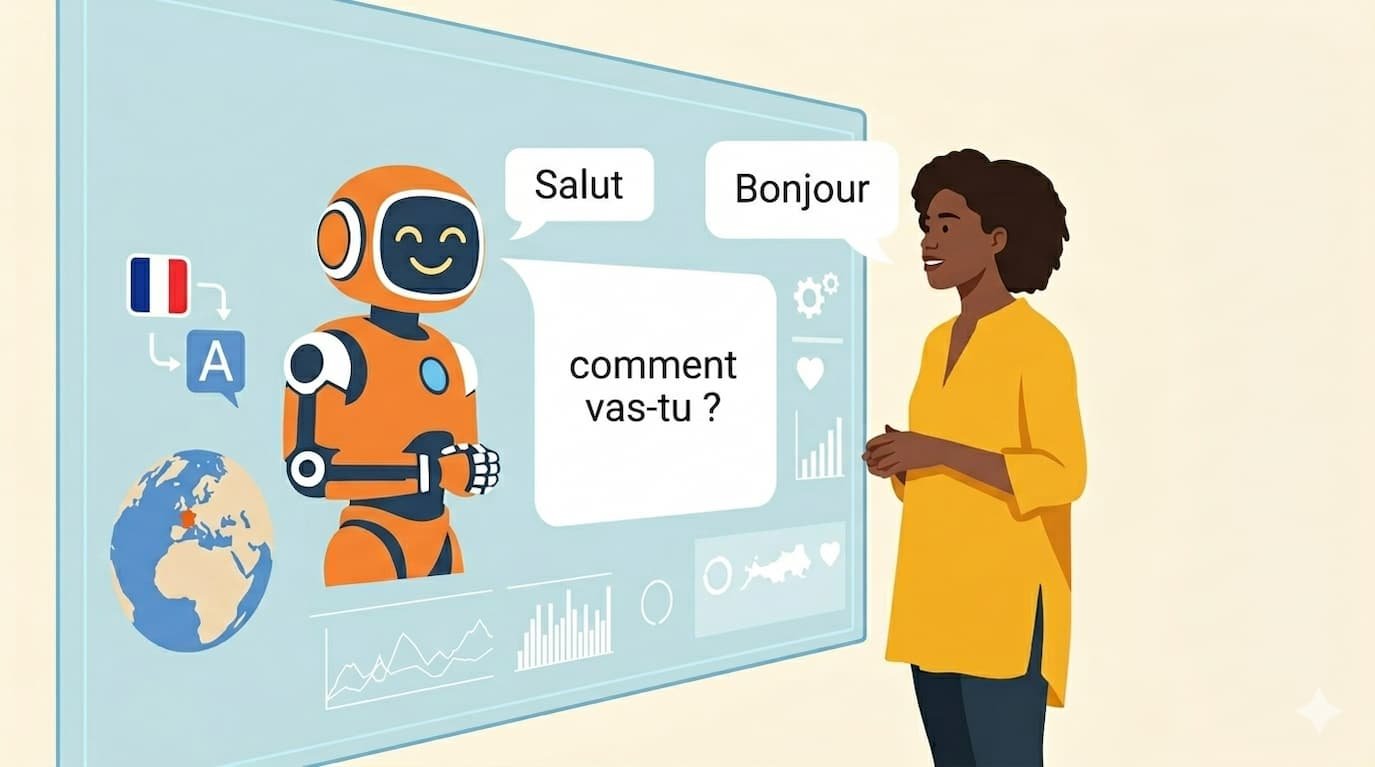
Traditional language learning apps usually rely on static, pre-packaged materials. Because the content is fixed, it’s easy to get stuck in a repetitive loop and quickly lose interest. In contrast, an AI-powered language app leverages Large Language Models (LLMs) trained on vast amounts of real-world, everyday human conversation. This allows the app to generate dynamic exercises that naturally expand your vocabulary and familiarize you with a wide range of authentic expressions.
To help you get the most out of your AI tutor and avoid repetitive exercises, here is your ultimate prompt guide – Sample prompts you can use right after AI’s initial greeting. You can shuffle and rotate them as you like.
1. Say a “[subject]” for the conversation:
- Introduction (Getting to know each other)
- Le voyage (Travel)
- Les directions (Directions)
- La nourriture (Food)
- Les vêtements (Clothing)
- Les couleurs (Colors)
- Les lieux (Places)
- L’appartement (The apartment / Housing)
- Les passe-temps (Hobbies)
- La météo / Le temps (Weather)
- Les dates et les jours (Dates and days)
- L’heure et la journée (Time and daily schedule)
- Les habitudes et les routines (Habits and routines)
- Les nationalités et langues(Nationalities and languages)
- La famille (Family)
- Le corps (Body)
- Le travail (Work)
- Les métiers (Professions)
- Les ordinateurs et internet(Computers and internet)
- L’argent et la banque (Money and bank)
- L’argot français (French slang)
- Les jurons français (French swear words / cuss words)
2. Say a scenario: “Je veux pratiquer des phrases pour [action]”
For travelers
- Demander le chemin (Asking for directions)
- Donner une direction (Giving a direction)
- Arriver à l’aéroport / à la gare (Arriving at the airport/train station)
- Prendre un taxi/bus/train (Taking a taxi/bus/train)
- Faire l’enregistrement à l’hôtel (Checking into a hotel)
- Commander au restaurant / au café (Ordering at a restaurant or café)
- Commander dans un fast-food (Ordering fast food)
For those who want to settle down
- Faire les courses (Grocery shopping)
- Faire du shopping (Going shopping)
- Acheter des fruits et des légumes (Buying fruits and vegetables)
- Acheter des vêtements ou des chaussures (Buying clothes or shoes)
- Passer à la caisse au supermarché (Checking out at the supermarket)
- Faire connaissance avec quelqu’un (Getting to know someone)
- Discuter avec un ami (Chatting with a friend)
- Retrouver des amis (Meeting up with friends)
- Proposer une sortie (Suggesting an outing / hanging out)
- Décrire comment cuisiner (Describe how to cook)
- Prendre un rendez-vous (Making an appointment)
- Ouvrir un compte bancaire (Opening a bank account)
- Acheter ou faire réparer un téléphone (Buying or repairing a phone)
- S’inscrire à la salle de sport (Signing up for the gym)
- Consulter un médecin (Consulting a doctor)
- Aller à un rendez-vous médical (Going to a medical appointment)
- Louer un vélo (Renting a bike)
- Louer un appartement (Renting an apartment)
For those who want to become residents
- Acheter une voiture (Buying a car)
- Acheter une propriété (Buying a property)
- Passer un entretien d’embauche (Having a job interview)
- Aller à un rendez-vous à la préfecture (Going to an appointment at the prefecture)
3. Say a location: “Je veux pratiquer le thème [place]”
- Au restaurant / café / bar (At the restaurant/coffee shop/bar)
- Au supermarché (At the supermarket)
- Au marché en plein air (At the open-air market)
- Au cinéma (At the movie theatre)
- À l’aéroport (At the airport)
- À la gare (At the train station)
- À l’hôtel (At the hotel)
- À la boulangerie (At the bakery)
- À la laverie (At the laundromat)
- À la banque (At the bank)
- À la pharmacie (At the pharmacy)
- À l’hôpital (At the hospital)
- À la poste (At the post office)
- À la salle de sport (At the gym)
- Chez le coiffeur (At the hair salon/barber)
- Chez le médecin (At the doctor’s office)
- Chez l’opticien (At the optometrist/optician)
- Dans un magasin de téléphonie (At a phone store)
- Dans un magasin de jouets (At a toy store)
- Dans une agence immobilière (At a real estate agency)
- Dans mon quartier (In my neighborhood)
- Dans ma ville (In my city)
- Au bureau / Au travail (At the office / At work)
4. Say a specific “[grammar]” point to practice
- Les adjectifs (Adjectives)
- Les adverbes de lieu (Adverbs of place)
- Les adverbes de temps (Adverbs of time)
- Les pronoms directs et indirects (Direct and indirect object pronouns)
- Les pronoms possessifs (Possessive pronouns )
- Les pronoms réfléchis (Reflexive pronouns)
- Les pronoms “En” et “Y” (The adverbial pronouns en and y)
- Les prépositions de lieu (Prepositions of place )