What exactly is a French language school?
Essentially, these are specialized institutions designed for international students of all ages and levels—from absolute beginners (A1) to advanced speakers (C2).
One of their biggest perks is flexibility. You can enroll anywhere from a single week to an entire year, with the option of choosing between half-day or full-day intensive tracks. Upon completing your courses, you receive an official certificate based on your final assessment. Beyond the classroom, most schools operate as a full-service experience, offering student accommodation, guided cultural tours, private tutoring, and targeted preparation for the DELF/DALF exams.
You can find qualified French language school from this map.
My 4-Month Experience: Expectation vs. Reality
When I first arrived in France, I spent four months studying at a local French language school. I wanted to share my firsthand experience to help you decide if booking a few classes is the right move for your next trip to France.
1. It is definitely not your typical school.
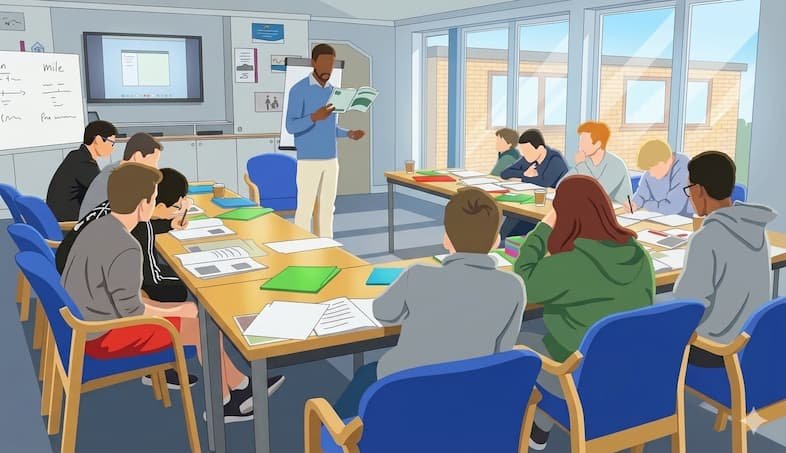
Forget the traditional, rigid classroom setting. Here, classes are small—usually around 6 to 12 people—and your classmates will be an incredibly diverse mix of ages and nationalities. Because the tracks are mostly half-day (around 3 to 3.5 hours) and most people only sign up for a few weeks, students are constantly coming and going. If you stay for months like I did, you’ll see a rotating door of new faces.
Because of this, the school felt less like a strict academic institution and more like an extension of a tourist program. The core focus is definitely on having fun experiences and sharing cultural exchanges, rather than intense academic grind.
2. The learning rhythm isn’t what you’d expect.
Don’t expect a steady, traditional curriculum here. While the school has general guidelines for what each language level should cover, there are no standard textbooks. Instead, everything is left up to the individual teacher, who designs their own syllabus and hands out loose-leaf materials on a daily or weekly basis.
While teachers do briefly explain grammar, the vast majority of your time is spent actively practicing as a class, in groups, taking turns, or working with a partner.
The pace is incredibly fast, and you might feel like you don’t get quite enough time to truly master one topic before moving on to the next. Plus, there’s a logistical quirk to look out for: if enrollment drops, the school will sometimes combine different levels into one classroom, pushing the lower-level students right into a higher-level track.
3. It’s not the best fit if you start from scratch.
If you are a total beginner, you might want to think twice. Most of the younger international students in these schools have already studied some French back home. For them, the main goal is simply to practice speaking and have fun.
If you’re hoping to start from zero, this environment can be tough. Even though these schools claim to offer “total beginner” tracks, the pace moves way too fast to actually absorb and practice the basics effectively. It’s hard to enjoy the experience when you constantly feel like you’re falling behind.
4. It may not be the best fit for senior learners.
Studying a new language later in life comes with a different set of challenges, and the learning habits we build over time can make it harder to adapt to a fast-paced environment. It can be difficult to keep up when younger classmates are memorizing vocabulary and picking up concepts at a much quicker pace.
On top of that, the teaching style itself can be a hurdle. Teachers frequently use fast-paced educational games to spark competition in the classroom. If you aren’t used to that kind of gamified environment, it can easily make you feel awkward or out of place.
5. Be skeptical of the marketing promises.
When you’re shopping for a language school, you’ll often see advertisements promising that you can reach a level like A2 in just a few months. In reality, that is rarely the case.
French is notoriously difficult to master—even if you already speak a Western language with similar roots like English, Spanish, or Italian. The language is packed with hurdles like complex verb conjugations, tricky pronunciation rules, masculine and feminine nouns, and spoken liaisons.
Don’t let flashy marketing lure you into booking months of study upfront and wasting your money. Go into it expecting that progress will likely take much longer than the brochure claims.
So, Are French Language Schools Worth It?
This school is for you if:
- You already studied French formally at home and have a foundation.
- You want to practice speaking with real people.
- You are staying in France for a short time (a few weeks).
- You want to meet people in a multicultural environment.
This school is NOT for you if:
- You are starting from scratch as a total beginner.
- You only learned French casually in your spare time in your home country.
- You are 50+ and unused to fast-paced classroom games or competition.
- You are staying in France long-term (months or years).