
French is hard for English speakers mainly because of five things: pronunciation, real-world vocabulary gaps, number-heavy conversations, complex conjugation, and unpredictable live conversation. The good news is each one has a specific fix — here’s what actually worked for me, and how to overcome them.
1. Nobody Understands Your French Pronunciation
I started learning French by repeating after YouTube creators. But when I moved to France, no one could understand me, whether I said cinq in class or ordered a thé at a coffee shop. Teachers in the French language school told me to work on my pronunciation, but never explained how.
Searching for French pronunciation apps yielded nothing. While reading textbooks aloud, I was afraid that I was only reinforcing bad habits. I desperately needed real-time feedback.
The solution: Use the French Pronunciation Coach on Parlez.app. It listens to any sentence you choose and corrects your mistakes in real time.
2. Cheat Sheets Don’t Match Real Conversations
Before my first trip to France, I built a 7-page cheat sheet of common phrases—English on one side, French on the other. I drilled it relentlessly, but it barely helped. Real conversations don’t follow a script, and my memorized lines covered only a fraction of what I actually needed to say.
Many suggest jumping straight into open-ended AI chats like ChatGPT for practice. But for a beginner, that’s overwhelming—you spend far too long searching for words mid-sentence, and the gap between what you want to say and your ability to say it is just too wide to bridge alone.
The solution: Use the French Fluency Boost on Parlez.app. It gives you dynamic practice for common sentences in any situation.
3. French Numbers Take Serious Mental Effort
Whenever someone asks for my phone number or birthdate in France, I secretly brace myself. Processing French numbers takes real mental gymnastics, made worse by phonetic traps like liaisons blending into words like ans or heures.
A French student once helped me by reading aloud ten random sentences containing numbers for me to catch and repeat. It was a fantastic exercise, but I couldn’t keep a tutor around 24/7.
The solution: Use the French Numbers feature on Parlez.app. AI generates infinite number drills whenever you need them.
4. French Conjugation Is Relentless
French conjugation is a relentless workout for English speakers, full of irregular verbs, endless tenses, and silent endings. Early on, I bought a pocket-sized conjugation booklet and studied it religiously, memorizing it page by page. But even after finishing the entire book, I still froze mid-sentence, stumbling over endings and mixing up tenses in live conversations.
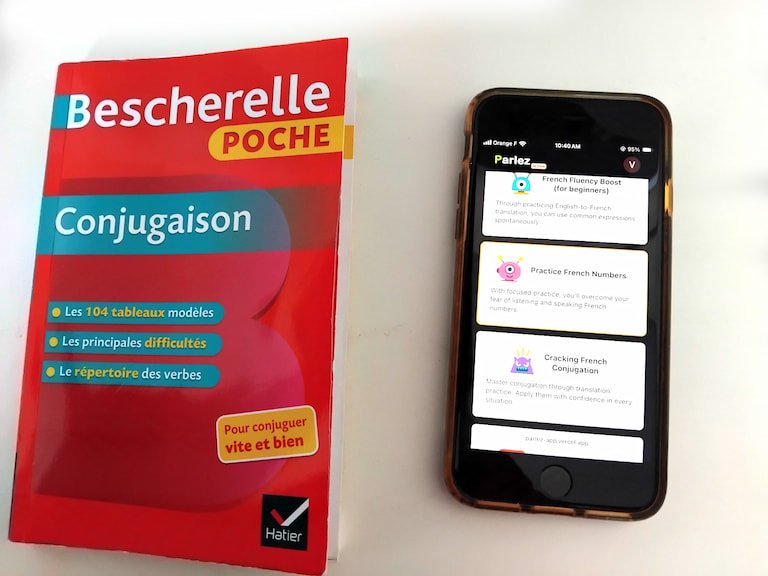
That’s when I realized the hard truth: Learning conjugation tables in isolation creates a massive gap. Flashcards and tables can only take you so far—the only way to truly master verb forms is by practicing them inside real, dynamic context.
The solution: Try the French Conjugation tool on Parlez.app. It lets you practice verb conjugations in the context of real, complete sentences.
5. Real Conversations Aren’t Scripted
Real-life conversations are completely dynamic—you never truly know how a native speaker will respond. This unpredictability aggressively tests your listening comprehension. If you can’t understand what someone says to you in real time, that friction alone can intimidate you and destroy your confidence to go out and speak French again.
Free-form tools like ChatGPT’s voice mode are genuinely useful for simulating this back-and-forth, but they aren’t actually designed for language learners. ChatGPT naturally defaults to complex phrasing geared toward problem-solving, rather than using accessible language structured to help you learn.
The solution: Use the Interactive Role-Playing on Parlez.app. This open-ended AI exercise gives you a low-stakes environment to practice dynamic conversation before engaging in real-life dialogues.
FAQs
1. Pronunciation: Nasal sounds and silent letters create a steep barrier to speaking naturally.
2. Conjugation: Endless tenses and irregular verb forms trap you in a cycle of overthinking mid-thought.
3. Numbers: Non-intuitive math rules combined with sound blending (liaisons) make everyday numbers surprisingly exhausting.
Try Parlez.app. You can use it anytime—24/7—with no need to schedule sessions. You can receive instant pronunciation feedback and build the muscle memory needed to speak French fluently.