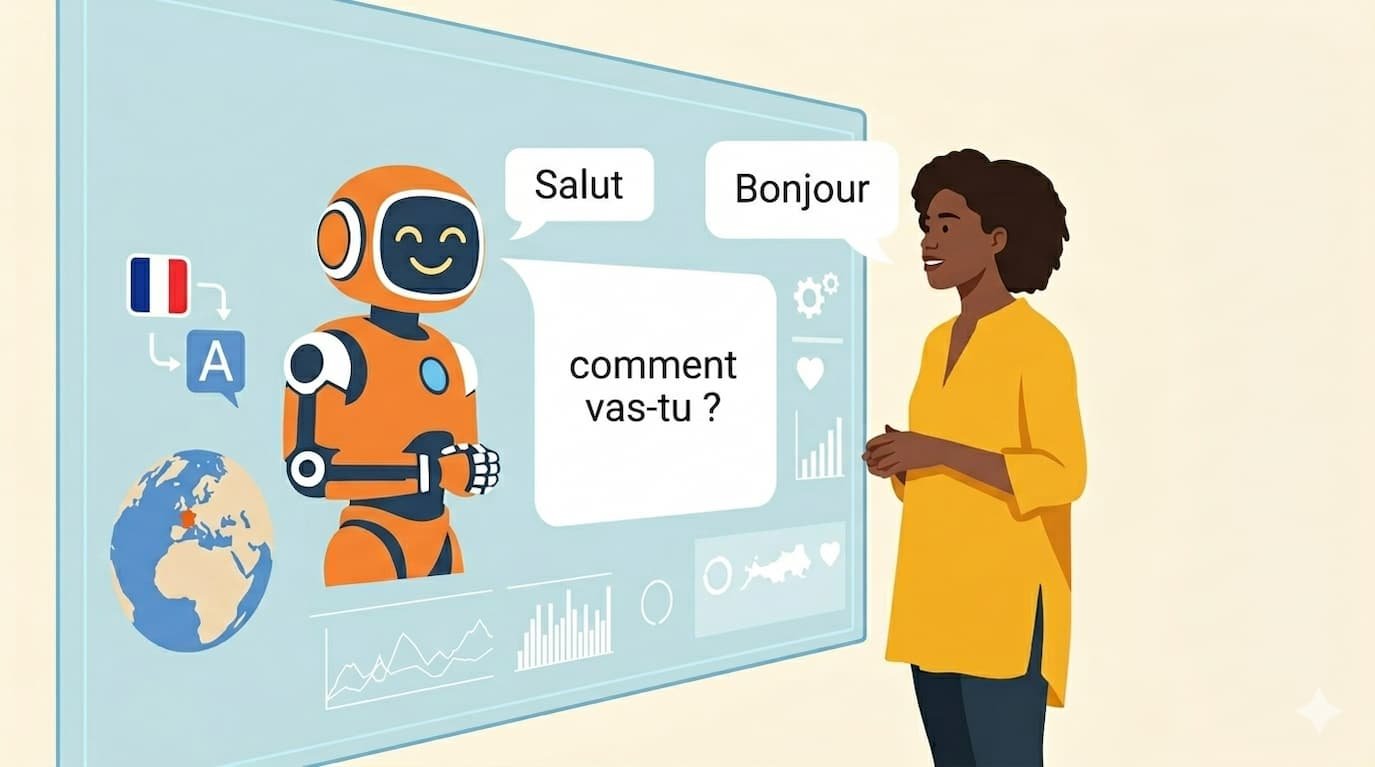
Traditional language apps rely on static, pre-packaged content, which makes it easy to fall into a repetitive loop and lose interest. AI-powered apps, by contrast, use Large Language Models (LLMs) trained on real-world conversations to generate dynamic exercises — helping you build vocabulary and pick up authentic expressions naturally.
Intro
● At the beginning of each session, your AI tutor will ask what you want to practice. Use the following prompt templates to response.
● Feel free to mix up your prompts as much as you like. Every session is different, offering far more variety and flexibility than a traditional textbook or human tutor.
● The prompts should work with any AI-powered French learning app that is prompt-based (ChatGPT, parlez.app), instead of scenario-based (Langua).
Now, let’s dive into the prompts to practice French with AI.
1. Je veux pratiquer [un sujet]
- L’introduction (demo)
- Le voyage (demo)
- Les directions (Directions)
- La nourriture / Les aliments (demo)
- Les vêtements (Clothing)
- Les lieux de ville (Places)
- L’appartement / Le logement (demo)
- La météo / Le temps (Weather)
- Les dates et les jours (Dates and days)
- L’heure (Time )
- Les habitudes et les routines (Habits and routines)
- Les nationalités et langues(Nationalities and languages)
- Les passe-temps / Les loisirs(Hobbies)
- Le sport (Sport)
- La famille (Family)
- Les couleurs (Colors)
- Le corps (Body)
- Le travail (Work)
- Les métiers (Professions)
- Les outils (Tools)
- Les ordinateurs et internet(Computers and internet)
- L’argent et la banque (Money and bank)
2. Je veux pratiquer [un point de grammaire]
- Les articles définis et indéfinis(demo)
- Les articles partitifs (demo)
- Les adjectifs possessifs (Possessive adjectives)
- Les pronoms possessifs (Possessive pronouns )
- Les adjectifs démonstratifs (Demonstrative adjectives)
- Les pronoms démonstratifs (Demonstrative pronouns)
- Les adverbes de temps (Adverbs of time)
- Les adverbes de lieu (Adverbs of place)
- Les adverbes de quantité(Adverbs of quantity)
- Les prépositions de temps (Prepositions of time)
- Les prépositions de lieu (Prepositions of place)
- Les verbes avec leur préposition (Verbs with their prepositions)
- Les pronoms directs et indirects (demo)
- Les verbes réfléchis (Reflexive verbs)
- Les pronoms disjonctifs / toniques (Disjunctive pronouns)
- Le pronom EN (pronouns en)
- Le pronom Y(pronouns y)
- Les pronoms interrogatifs (Interrogative pronouns)
- Les pronoms relatifs (Relative pronouns)
- Les conjonctions(Conjunctions)
- Le comparatif et le superlatif (Comparatives & superlatives)
3. Je veux pratiquer [les phrases]
- Les phrases courtes pour la vie quotidienne (Short phrases for everyday life)
- Les phrases courtes de questions-réponses (Short question-and-answer sentences)
- Les phrases courtes entre 2 amis (Short phrases between two friends)
- L’impératif entre 2 amis (The imperative between two friends)
- L’argot français (French slang)
- Les jurons français (French swear words)
4. Je veux pratiquer le thème [à un endroit]
- Au restaurant / café / fast-food (demo)
- Au supermarché (At the supermarket)
- Au marché de producteurs (At the farmers’ market)
- Au magazine (At the store)
- À l’aéroport (demo)
- À la gare (demo)
- À l’hôtel (demo)
- À la boulangerie (At the bakery)
- À la laverie (At the laundromat)
- À la banque (At the bank)
- À la pharmacie (At the pharmacy)
- À la poste (At the post office)
- À la salle de sport (At the gym)
- Dans une agence immobilière (At a real estate agency)
- Dans un magasin de téléphonie (At a phone store)
- Chez le coiffeur (At the hair salon/barber)
- Chez le dentiste (At the dentist)
- Chez l’opticien (At the optometrist/optician)
5. Je veux pratiquer des phrases pour [une action]
As a traveler
- Demander le chemin (Asking for directions)
- Donner une direction (Giving a direction)
- Arriver à l’aéroport (Arriving at the airport)
- Faire une correspondance à la gare (Changing trains at the station)
- Prendre un taxi/bus (Taking a taxi/bus)
- Faire l’enregistrement à l’hôtel (Checking into a hotel)
- Commander au restaurant / au café (Ordering at a restaurant or café)
- Commander dans un fast-food (Ordering fast food)
Meet people
- Parler des loisirs (Talking about hobbies)
- Parler de la routine quotidienne (Talking about daily routine)
- Proposer de sortir (Proposing going out)
- Parler de la journée hier (Talking about yesterday)
- Parler de mon problème à mon ami (Talking about my problem to my friend )
- Exprimer des sentiments (Express feelings)
- Parler de la météo (Talking about the weather)
- Parler de la météo hier (Talking about yesterday’s weather)
- Parler de la météo demain (Talking about tomorrow’s weather)
- Parler du dernier voyage (Talking about the last trip)
- Parler du futur voyage (Talking about a future trip)
- Décrire une personne (Describing a person)
- Décrire la recette du plat (Describing the recipe)
- Parler du travail (Talking about work)
- Discuter avec des collègues (Chating with colleagues)
- Discuter des idées (Discussing the ideas)
Get services
- Faire les courses (Grocery shopping)
- Faire du shopping (Going shopping)
- Acheter des fruits et des légumes (Buying fruits and vegetables)
- Acheter des vêtements ou des chaussures (Buying clothes or shoes)
- Acheter de la viande et des fruits de mer (Buying meat and seafood)
- Passer à la caisse au supermarché (Checking out at the supermarket)
- Envoyer un colis (mailing a package)
- Acheter ou réparer un téléphone (Buying or repairing a phone)
- S’inscrire à la salle de sport (Signing up for the gym)
- Ouvrir un compte bancaire (Opening a bank account)
- Aller chez le médecin (Going to a medical appointment)
- Louer un vélo (Renting a bike)
- Louer un appartement (Renting an apartment)
6. Je veux pratiquer [un temps verbal]
- Le présent (demo)
- L’impératif (demo)
- Le futur proche (demo)
- Le passé composé (demo)
- Le passé composé à la négative
- Le passé composé sur un verbe pronominal
- Le passé composé sur un verbe pronominal à la négative
- Le passé composé avec les pronoms directs et indirects
- Le passé composé avec les pronoms directs et indirects à la négative
- l’imparfait (demo)
- Le futur simple (demo)
- Le conditionnel